Translation Then Attestation, or Attestation Then Translation? Getting the Order Right
One of the most common mistakes we see is applicants getting a document translated and attested in the wrong order — then having to redo one of the two steps because the receiving authority won’t accept what’s in front of them. The right sequence depends on the type of document and what happens to it afterwards.
This guide lays out the correct order for the most common document types, why the sequence matters, and what to do if you’ve already gotten it backwards.
Why the Order Matters: MOFA Attests the Original, Not the Translation
MOFA attestation verifies the authenticity of an original document — the signatures, stamps, and prior attestations already on it — not the wording of any translation attached to it. A certified translation, by contrast, is a separate document produced and stamped by a Ministry of Justice-licensed legal translator, and it is certified independently of MOFA’s process.
Because these are two separate steps performed by two different bodies, doing them in the wrong order commonly means one of the steps has to be repeated. If a translation is produced before an earlier attestation step (like notarization) is complete, the translation may not match what MOFA later attests, and MOFA or the next authority in line can reject the mismatch.
The Typical Correct Sequence by Document Type
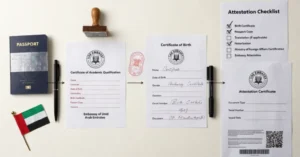
For most personal documents (birth, marriage, and educational certificates) issued outside the UAE, the general sequence is: attestation in the country of origin (notarization and that country’s foreign ministry) → UAE embassy attestation abroad → MOFA attestation in the UAE → certified Arabic translation, if the receiving UAE authority requires it. Translation comes last in this chain because it needs to reflect the document exactly as it stands once every prior stamp is already in place.
For documents that already originate in the UAE and need to go abroad, the order often runs the other way: notarization → MOFA attestation → translation into the destination country’s language, if required, followed by that country’s embassy legalisation. Our step-by-step MOFA attestation guide walks through the full chain for the most common scenarios.
What Happens If You Get the Sequence Backwards
The most common consequence of the wrong order is simple rejection: if a translation was prepared before all the attestation stamps it should reflect are actually on the document, the receiving authority may not accept it, and the translation has to be redone once the correct stamps are in place. In a courier-based process, this usually means an extra round trip and an extra fee.
It can also cause confusion further down the chain — an embassy or receiving institution abroad may question why the translation doesn’t match the document’s final attested state. The safest approach is always to confirm the required sequence for your specific document and destination before paying for translation.
A Simple Flow for Getting It Right the First Time
As a general rule of thumb: notarize or verify the original first → complete any prerequisite attestations (Ministry of Education for academic documents, Chamber of Commerce for commercial ones) → get MOFA attestation → then translate, if the receiving authority needs the document in a different language. Confirm this order with whoever is receiving the final document, since requirements can vary by embassy, court, or institution.
If you’re not sure where your document sits in this chain, it’s faster to ask before you start than to redo a step afterwards — Dunes checks the sequence for you before any translation or attestation work begins.
PEOPLE TRUST
We Are Best


Approved by Ministry of Justice

24x7 Hours Customer Support

Free Pickup &
Delivery

How to Get Started
Does MOFA ever attest a translated document instead of the original?
No. MOFA attests the original document and the chain of stamps already on it. A certified translation is a separate document, produced and stamped independently by a Ministry of Justice-licensed legal translator.
What if my document was already translated before any attestation steps?
It depends on the document and destination, but in many cases the translation will need to be redone once the required attestations are complete, so that it accurately reflects the document’s final, attested state. Check with Dunes or the receiving authority before relying on an early translation.
Does the sequence change for documents issued outside the UAE?
Yes. Foreign-issued documents typically go through attestation in the country of origin and at the UAE embassy there before MOFA attestation in the UAE, with certified Arabic translation usually coming last if it’s required. UAE-issued documents heading abroad generally follow the reverse order.
Can Dunes handle the whole sequence for me?
Yes. Dunes manages notarization support, MOFA attestation, and certified Arabic translation as a single coordinated process, so each step happens in the correct order the first time.