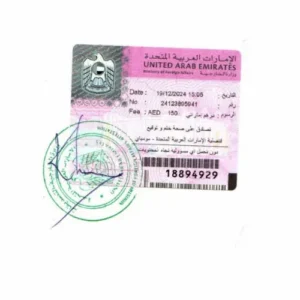
Do You Need MOFA Attestation for a Power of Attorney Issued Abroad?
If you’re holding a Power of Attorney that was signed and notarized outside the UAE — for a property sale, a banking matter, or to let a representative act for you in a UAE court — you can’t simply hand it to a bank, a developer, or a court clerk and expect it to be accepted. A foreign-issued POA only becomes usable in the UAE once it has passed through a recognized attestation chain that ends with the UAE Ministry of Foreign Affairs (MOFA).
This guide explains why that step exists, how MOFA’s role differs from the issuing country’s own foreign ministry and the UAE’s overseas missions, and the order those steps need to happen in.
Why a Foreign Power of Attorney Isn’t Automatically Valid in the UAE
UAE institutions — banks, the Dubai Land Department, courts, and the Dubai Courts Notary Public — generally don’t accept a foreign-issued legal document, including a Power of Attorney, purely on trust in a notary from another country. A notarized signature carries authority in the country where it was signed, but UAE authorities have no direct way to confirm that a given foreign notary’s seal or signature is genuine.
Attestation closes that gap. Each authority in the chain verifies the authenticity of the seal or signature from the authority before it, so that by the time the document reaches MOFA in the UAE, its origin has been confirmed step by step. Without that chain in place, a UAE bank, government department, or court is entitled to reject the POA outright, however clearly it’s drafted.
MOFA’s Role vs. the Issuing Country’s Foreign Ministry and Embassy
It helps to separate out who does what, since three different authorities are typically involved before a foreign POA is usable in the UAE:
The issuing country’s Ministry of Foreign Affairs (or equivalent authority) attests the notarized document to confirm that the notary who signed it is genuinely authorized in that country.
The UAE Embassy or Consulate in that country then legalizes the document, effectively confirming it is now ready to be presented to UAE authorities.
The UAE Ministry of Foreign Affairs issues the final attestation once the document has reached the UAE, via the MOFA smart application or an approved courier channel. This is the stamp that UAE banks, government departments, and courts recognize.
It’s worth noting that MOFA’s attestation confirms the authenticity of the chain of signatures and seals — it isn’t a review of the POA’s legal content, and it doesn’t replace any separate requirement that a receiving authority (such as a specific bank or court) may have.
The Attestation Chain, Step by Step
The exact steps can vary slightly by country, but for most foreign-issued POAs the sequence looks like this:
1. Notarization in the country of origin. The POA is signed before a notary public or equivalent local authority in the country where it’s issued.
2. Attestation by that country’s Ministry of Foreign Affairs. Some countries route this through an apostille-issuing authority instead — but since the UAE is not itself a member of the Hague Apostille Convention, an apostille on its own is not normally treated as the final step for UAE use. It’s best to confirm with the UAE Embassy in that country, or with Dunes, exactly what’s still required for your specific document.
3. Legalization at the UAE Embassy or Consulate in the country where the POA was issued.
4. Final attestation by MOFA once the document is in the UAE.
If the POA isn’t already in Arabic, UAE authorities will typically also expect a certified Arabic translation from a UAE Ministry of Justice-licensed legal translator, usually completed alongside or after the attestation steps rather than before them.
Common Situations Where This Comes Up
A foreign-issued POA that needs UAE MOFA attestation shows up most often in a few recurring situations:
Property. Appointing someone to complete a Dubai Land Department sale, purchase, or transfer on your behalf while you’re outside the UAE.
Banking. Authorizing a representative to open, manage, or act on an account, or to complete a specific banking transaction, when you can’t be present yourself.
Court and legal matters. Authorizing a lawyer or representative to act on your behalf in UAE litigation, an inheritance matter, or a contractual dispute.
In every one of these cases, the receiving authority — the bank’s compliance team, the Land Department, or the court — is the one that ultimately decides what it will accept, so it’s worth confirming their exact requirement before you start the attestation process.
PEOPLE TRUST
We Are Best


Approved by Ministry of Justice

24x7 Hours Customer Support

Free Pickup &
Delivery

How to Get Started
If you have a Power of Attorney issued outside the UAE — or you’re preparing one to bring into the country — Dunes can manage the full attestation chain for you: coordinating with the issuing country’s foreign ministry and the UAE Embassy where needed, arranging a certified Arabic translation where required, and completing the final MOFA attestation once it’s in the UAE. Browse our full range of Power of Attorney services, or contact us to check exactly what your document and receiving authority will require.
Does every foreign Power of Attorney need MOFA attestation in the UAE?
Most POAs issued outside the UAE need MOFA attestation before a UAE bank, court, or government department will rely on them, since these authorities generally expect documents to pass through the full legalization chain before treating them as authentic. Some informal, private-party uses may not strictly require it, but it is safest to confirm with the specific receiving authority before assuming attestation can be skipped.
Can I use an apostille instead of the full attestation chain?
The UAE is not a member of the Hague Apostille Convention, so an apostille from the issuing country is not normally accepted on its own as a substitute for the full chain — the document will typically still need UAE Embassy legalization and MOFA attestation once it reaches the UAE. Requirements can vary by country of origin, so it is worth confirming the exact steps with the UAE Embassy there or with Dunes.
Does a foreign POA need to be translated into Arabic?
If the POA is not already in Arabic, UAE authorities will generally expect a certified Arabic translation from a UAE Ministry of Justice-licensed legal translator, typically arranged alongside or after the attestation steps. An uncertified or informal translation is usually not accepted.
How long does attestation of a foreign POA take?
Timelines depend on the issuing country, how quickly its foreign ministry and the relevant UAE Embassy process documents, and the courier or digital route used once the document reaches the UAE, so it is not possible to quote a single reliable figure. Dunes can give you a realistic estimate once we know the document and country involved, and can help you plan around a specific deadline.