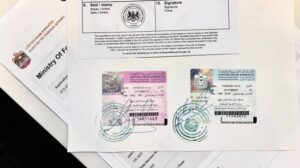
Attesting a UAE Power of Attorney for Use in Another Country (MOFA + Embassy Steps)
If you hold a Power of Attorney (POA) issued and notarized in the UAE and need it to be legally recognized in another country — for a property sale, a bank matter, or legal representation abroad — notarization alone usually isn’t enough. Most foreign authorities expect a clear chain of verification: first confirming the UAE notary’s signature is genuine, then confirming the destination country’s embassy in the UAE has legalized that verification for use in their jurisdiction.
This guide walks through when outbound POA attestation applies, the correct MOFA-plus-embassy sequence to follow, what translation the destination country may expect, and how to plan realistically around the timeline — so your document is accepted the first time, without delays.
When Does Outbound POA Attestation Apply?
Not every UAE-issued Power of Attorney needs MOFA attestation. If your POA will only ever be used inside the UAE — at a UAE bank, with a UAE developer, or in a UAE court — notarization through an authorized UAE notary is typically sufficient on its own.
Outbound attestation becomes necessary the moment your POA needs to work outside the UAE: selling property abroad, managing a bank account in your home country, appointing someone to represent you in a foreign court case, or handling an inheritance matter overseas. In these situations, the receiving authority — a foreign bank, land registry, court, or government office — has no independent way to confirm that your UAE notary’s stamp and signature are genuine. MOFA attestation, followed by the destination country’s embassy legalization, is what closes that gap and gives the document standing outside the UAE.
If you’re unsure whether your specific use case needs this step, the safest approach is to ask the receiving institution directly what form of legalization they require, or let Dunes review the situation and confirm before you proceed.
The Correct Sequence: Notarization → MOFA → Embassy Legalization
Getting the order right matters as much as completing each step. The standard chain for a UAE-issued POA headed abroad runs as follows:
1. Notarization in the UAE — The POA is first drafted and signed before an authorized UAE notary (a Ministry of Justice notary public office or an authorized private notary). This is the foundational step; nothing downstream can proceed without it.
2. MOFA attestation — The UAE Ministry of Foreign Affairs & International Cooperation (MOFA) verifies the notary’s signature and seal and adds its own attestation, confirming the document genuinely came from a recognized UAE notarial process. This can typically be done through MOFA’s own digital channel for eligible documents, or via an authorized typing centre or agent such as Dunes.
3. Destination embassy legalization — Once MOFA has attested the document, the embassy or consulate of the destination country (based in the UAE) legalizes it on their end, accepting MOFA’s verification as the basis for recognizing the document in their own country.
One important note: the UAE is not a member of the 1961 Hague Apostille Convention, so an apostille is not an option for UAE-issued documents, even if the destination country is itself a Hague member. The notarization-MOFA-embassy legalization chain described above is the UAE’s equivalent route, and it applies regardless of whether your destination country uses apostilles for documents from other countries.
Does Your POA Need a Certified Translation First?
Whether translation is required — and at what stage — depends on the language the destination country expects and the language your POA is currently in.
If your POA is already in Arabic, or in a bilingual Arabic/English format that your destination country accepts, you may not need a separate translation before MOFA attestation. If the destination requires the document in a different language, a certified legal translation is usually needed. In the UAE, that translation should come from a Ministry of Justice-licensed legal translator — an informal or uncertified translation is routinely rejected at this stage, which can send the whole process back to the start. See Dunes’ legal translation services for how this step fits into the overall sequence.
Some destination embassies also require their own in-country certified translation in addition to anything done in the UAE, so it’s worth checking the specific embassy’s requirements before you finalize your translation arrangements.
Realistic Timelines: What to Expect
There’s no single official duration for the full outbound attestation process, since it depends on three separate processes that aren’t under the same authority’s control.
The UAE notarization step is usually completed quickly, often within the same day at a notary public office. MOFA attestation can be comparatively fast when done through the digital portal for eligible documents, though courier or typing-centre routes may add a business day or more. The destination embassy’s legalization step is the least predictable part of the chain — processing times vary widely by embassy, by season, and by current workload, and some embassies require an appointment booked well in advance.
Because of this, it’s worth starting the process as early as possible once you know you’ll need an outbound-attested POA, and checking directly with the relevant embassy for their current turnaround before you commit to a deadline. Dunes can coordinate and track each stage of this process on your behalf, including liaising with typing centres and following up on embassy appointments, so you’re not left chasing three separate offices yourself.
PEOPLE TRUST
We Are Best


Approved by Ministry of Justice

24x7 Hours Customer Support

Free Pickup &
Delivery

How to Get Started
Attesting a UAE Power of Attorney for use abroad involves several moving parts — the UAE notary, MOFA, a certified translator if needed, and a foreign embassy with its own timeline. If you’re working through a related step, our guide on MOFA attestation for POA documents used outside the UAE covers the attestation requirements in more depth. For a free review of your specific situation and a clear next step, contact Dunes and we’ll help you get it done right the first time.
Do I need MOFA attestation if my UAE Power of Attorney will be used abroad?
In most cases yes — many foreign authorities, banks, and courts require any UAE-issued legal document, including a POA, to carry MOFA’s attestation (and often the destination country’s embassy legalization) before they’ll accept it as valid, since this is how they verify the document came from a recognized UAE process. Requirements vary by country and by receiving institution, so it’s worth confirming with the specific authority.
Is an apostille an alternative to MOFA attestation and embassy legalization for a UAE POA?
No — the UAE is not a member of the Hague Apostille Convention, so an apostille isn’t available for UAE-issued documents. MOFA attestation followed by the destination country’s embassy legalization is the equivalent route.
Does my Power of Attorney need to be translated before MOFA attestation?
It depends on the language. If the POA is already in Arabic, or in a bilingual format the receiving country accepts, translation may not be required before MOFA. If it needs to go into another language for the destination country, a certified legal translation from a UAE Ministry of Justice-licensed translator is typically required first.
How long does the full attestation and legalization process take?
It varies by case — UAE notarization and MOFA attestation can often be completed within a few business days depending on the method used, but the destination embassy’s own legalization timeline depends entirely on that embassy’s processing times and current workload. Contact the specific embassy for their current timeline, or let Dunes coordinate and track each stage for you.