How to Get a Power of Attorney in Dubai: A Step-by-Step Guide
Granting someone the legal authority to act for you in Dubai — whether it’s to sign a contract, sell property, or manage a bank account — requires more than a signed letter.
This guide walks through exactly how to get a Power of Attorney prepared, translated and notarized in the UAE, from your first decision to a document you can actually use.
Choosing the Right Type of Power of Attorney & Your Agent
Start by defining the scope of what you need. A General Power of Attorney covers a broad range of matters, while a Special Power of Attorney is limited to one specific transaction, such as selling a car or completing a property handover. If the POA is for a company, you’ll need a Corporate Power of Attorney instead, and if it involves real estate, a Property Power of Attorney tailored to Dubai Land Department requirements.
Once you know the type, choose your agent — also called the attorney-in-fact. This can be a family member, business partner, lawyer, or trusted representative. Their full legal name and identification details (passport or Emirates ID) need to be included in the document.
Documents You’ll Need & Drafting the POA
Most POAs require:
Your original passport and Emirates ID or visa page (if a resident)
Passport copy of the appointed agent
Details of the specific matter the POA will cover
Company documents, if the POA is for corporate representation
A title deed, if the POA is for a property matter
The document itself needs to state clearly who is granting the authority, who is receiving it, and exactly what powers are being delegated. Vague wording is one of the most common reasons a POA gets rejected at the notarization stage, so it’s worth having it drafted by someone familiar with what UAE authorities expect.
Certified Translation, Notarization & Overseas Attestation
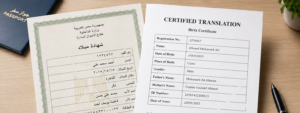
Many UAE authorities require the POA in Arabic, or bilingually in English and Arabic. Certified legal translation should be completed before your notarization appointment, since correcting it afterward means starting the notarization process again.
Notarization is the step that makes your POA legally valid — this could mean notarization at Dubai Courts, through the Ministry of Justice (MOJ) system, or via a private notary. See our full breakdown in Power of Attorney Notarization Services.
If your POA needs to be used outside the UAE, or you’re signing it from abroad for use in Dubai, an extra attestation step is required, typically through the relevant embassy and the Ministry of Foreign Affairs. We cover this in detail in Power of Attorney for Overseas Use.
Processing Time & Common Mistakes to Avoid
A standard Power of Attorney notarized within the UAE is usually completed within one to two working days once drafting and translation are finished. Cross-border attestation for overseas use can take longer, depending on the destination country’s embassy processing times.
The most common mistakes to avoid:
Using vague or overly broad wording that gets rejected at notarization
Skipping certified translation when the receiving authority requires it
Assuming a POA can be signed and used online without any in-person step
Combining unrelated powers into a single document instead of drafting a Special POA for each purpose
PEOPLE TRUST
We Are Best


Approved by Ministry of Justice

24x7 Hours Customer Support

Free Pickup &
Delivery

How to Get Started
Visit our Power of Attorney Services in Dubai page to get started, or reach out through our Contact Us page to tell us about your situation.
What's the difference between a General and Special Power of Attorney?
A General Power of Attorney covers a broad range of matters on your behalf, while a Special Power of Attorney is limited to one specific transaction, such as selling a vehicle or completing a single property handover. Most people only need a Special POA unless their situation genuinely requires broader authority.
Do I need to be present in Dubai to sign a Power of Attorney?
Not necessarily. If you’re abroad, the POA can typically be signed at the UAE Embassy or consulate in your country and then attested for use in the UAE, or drafted and notarized remotely depending on the receiving authority’s requirements.
Does a Power of Attorney need to be translated into Arabic?
Many UAE authorities, including Dubai Courts and the Ministry of Justice, require the POA in Arabic or bilingually in English and Arabic before notarization. It’s best to arrange certified legal translation before your notarization appointment to avoid delays.
How long is a Power of Attorney valid in the UAE?
Validity depends on how the POA is drafted — some are open-ended, while others state a fixed expiry date or are limited to a single transaction. It’s best to specify the intended duration clearly when drafting the document.