How MOFA Attestation Differs From MOJ Attestation for POA Documents
If you’ve started researching Power of Attorney requirements in the UAE, you’ve likely run into both “MOJ” and “MOFA” attestation — often used as if they’re interchangeable. They’re not. The Ministry of Justice (MOJ) and the Ministry of Foreign Affairs & International Cooperation (MOFA) play two different roles in the life of a UAE Power of Attorney, and knowing which one applies to your situation can save you a wasted trip and a delayed document.
This guide breaks down exactly what each ministry does, and how to tell whether you need one of them, the other, or both.
MOJ’s Role: Notarizing and Registering Your POA
The UAE Ministry of Justice oversees the country’s notarization system — the network of notary public offices (and authorized private notaries) where a Power of Attorney is drafted, signed, and formally registered. This is the step that creates your POA as a legally valid document within the UAE in the first place.
MOJ’s remit also extends to licensing the UAE’s legal translators, relevant if your POA, or supporting documents behind it, need to be translated into Arabic as part of the notarization process. Without this MOJ-notarized foundation, there’s nothing for any other authority — including MOFA — to attest.
MOFA’s Role: Attestation for Cross-Border Recognition
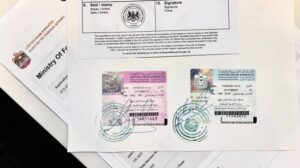
The Ministry of Foreign Affairs & International Cooperation doesn’t notarize or register your POA — it verifies that an already-notarized document is genuine, by checking the signature and seal of the notary who issued it, and then adds its own attestation confirming that verification.
This matters specifically when your POA needs to be recognized outside the UAE, or when a POA issued in another country needs to be recognized inside the UAE. MOFA attestation is the bridge that lets a foreign bank, court, land registry, or government office trust that your document went through a legitimate UAE notarial process — it is a step on top of notarization, not a substitute for it. See Dunes’ MOFA attestation service for how this step is typically handled.
Do You Need MOJ, MOFA, or Both?
The answer comes down to where the POA will actually be used.
If your Power of Attorney will only ever be used domestically — at a UAE bank, with a UAE developer, or in a UAE court — MOJ notarization is generally all that’s required. There’s no cross-border recognition question to solve, so MOFA attestation adds no value.
If the POA needs to be used abroad, or is a foreign POA being brought into the UAE for local use, you’ll typically need both steps: MOJ notarization (or the equivalent authority in the issuing country) first, followed by MOFA attestation — and, in many cases, a further legalization step by the receiving country’s embassy. Because requirements can vary by receiving institution and by country, it’s worth confirming directly with the receiving authority, or letting Dunes review your specific situation before you proceed.
PEOPLE TRUST
We Are Best


Approved by Ministry of Justice

24x7 Hours Customer Support

Free Pickup &
Delivery

How to Get Started
If you’re still working out whether your Power of Attorney needs MOJ notarization, MOFA attestation, or both, our detailed guide on the Ministry of Justice Power of Attorney process in the UAE is a good next read. For a straightforward answer based on your specific document and destination, contact Dunes and we’ll point you to exactly what’s needed.
Is MOJ attestation the same as MOFA attestation?
No — they’re different steps performed by different authorities. The Ministry of Justice (MOJ) oversees the notarization and registration of your Power of Attorney within the UAE; the Ministry of Foreign Affairs (MOFA) separately attests that already-notarized document so it’s recognized outside the UAE, or, for a foreign POA, recognized inside the UAE.
Do I need both MOJ notarization and MOFA attestation for my POA?
It depends on where the POA will be used. For purely domestic use within the UAE, MOJ notarization is usually enough. If the POA needs to be used or recognized abroad — or is a foreign POA being used in the UAE — you’ll generally need both steps, often followed by the relevant embassy’s legalization. Confirm with the receiving authority for your specific case.
Can MOFA attest a POA that hasn't been notarized first?
No — MOFA attestation verifies an existing notary’s signature and seal, so the POA must already be properly notarized and registered before MOFA can attest it. Skipping the notarization step means MOFA has nothing to verify.
Where can I get my Power of Attorney notarized before MOFA attestation?
UAE Powers of Attorney are typically notarized through an MOJ notary public office or an authorized private notary. See our guide on the Ministry of Justice Power of Attorney process for the full detail.